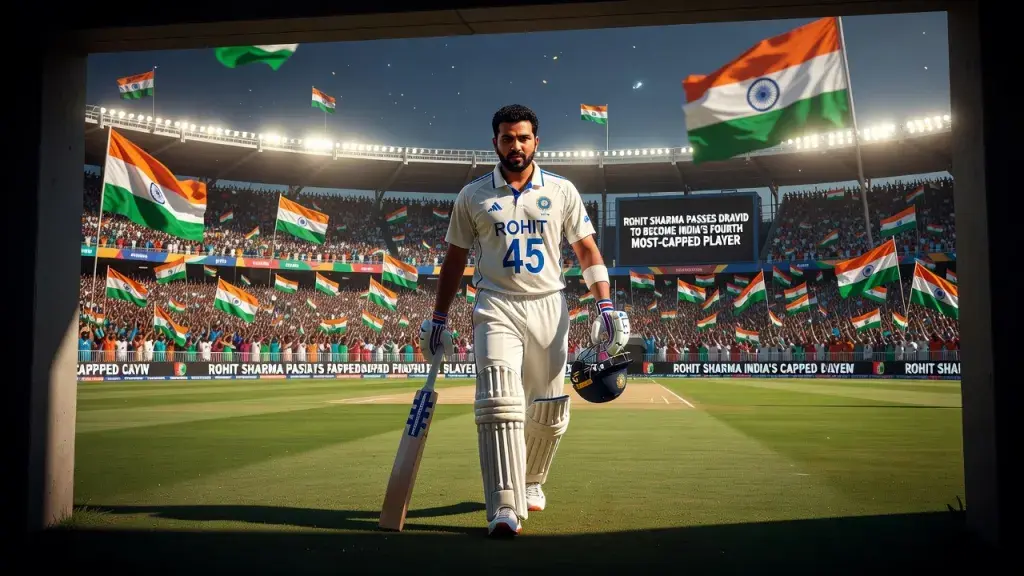
Rohit Sharma will etch his name into another page of Indian cricket history when he takes the field for the second ODI against Afghanistan on June 17. By appearing in that match, the veteran opener will surpass Rahul Dravid's international cap tally and stand alone as India's fourth most-capped player across all formats. It is a milestone that reflects the remarkable breadth and longevity of a career that very nearly never reached its full potential.
Rohit currently shares the fourth spot on India's all-time appearances list with Dravid, both having accumulated the same combined total across formats. Once the second ODI begins in Bengaluru, Dravid drops to fifth. The significance of this moment is not lost in a country where cricket operates on an almost mythological scale, and where individual records carry weight far beyond the numbers themselves. Across major sports globally - from the iran superleague basketball to the grandest Test match arenas - milestone appearances speak to commitment and durability that transcends any single performance. For Rohit, this milestone is a testament to exactly that.
The numbers themselves are striking. Rohit has represented India in 283 ODIs, 67 Tests and 159 T20Is - a combined 509 international appearances. Dravid, widely regarded as one of the finest batters India has ever produced, played 164 Tests, 344 ODIs and one T20I before retiring in 2012. That Rohit has surpassed a player of Dravid's standing underlines just how central he became to Indian cricket across three formats over nearly two decades.
A Career That Nearly Stalled Before It Soared
Rohit's path to this record was far from straightforward. He made his ODI debut against Ireland in June 2007, the same summer he won a T20 World Cup medal as part of MS Dhoni's history-making squad. Yet despite that early promise, selectors left him out of the 2011 ODI World Cup squad on home soil - a decision that, at the time, cast genuine doubt over whether he would ever fully establish himself at international level.
The turning point arrived with the 2013 Champions Trophy, when Dhoni promoted Rohit to open the batting in the fifty-over format. The results were transformative. Freed from the pressure of coming in during the middle overs and tasked with setting the tempo at the top, Rohit flourished. He became one of the most destructive opening batters in the global game, a player capable of rewriting match situations inside a powerplay. He cemented his Test place in 2019, going on to accumulate 4,301 runs in the longest format, while his 4,231 T20I runs made him one of India's most prolific run-scorers across white-ball cricket.
The Last Chapter: ODIs Only
Rohit has since retired from both Test cricket and T20Is, leaving the fifty-over format as his sole remaining arena. That makes the Afghanistan series more than a routine bilateral assignment - it is part of the final chapter of a long and decorated international career. Having led India to the ICC T20 World Cup title in 2024 and the Champions Trophy triumph in 2025, he arrives at this milestone as a two-time ICC tournament-winning captain, a status that places him firmly among the elite in Indian cricket's post-independence history.
The record he is about to claim belongs to a list that begins with Sachin Tendulkar, MS Dhoni and Virat Kohli. To sit fourth on that roster, ahead of Rahul Dravid - a man whose technical mastery and mental fortitude earned him the nickname "The Wall" - is a measure of how far Rohit has travelled since those uncertain early years. When he walks out to bat against Afghanistan on June 17, the occasion will carry weight that goes well beyond the match itself.