
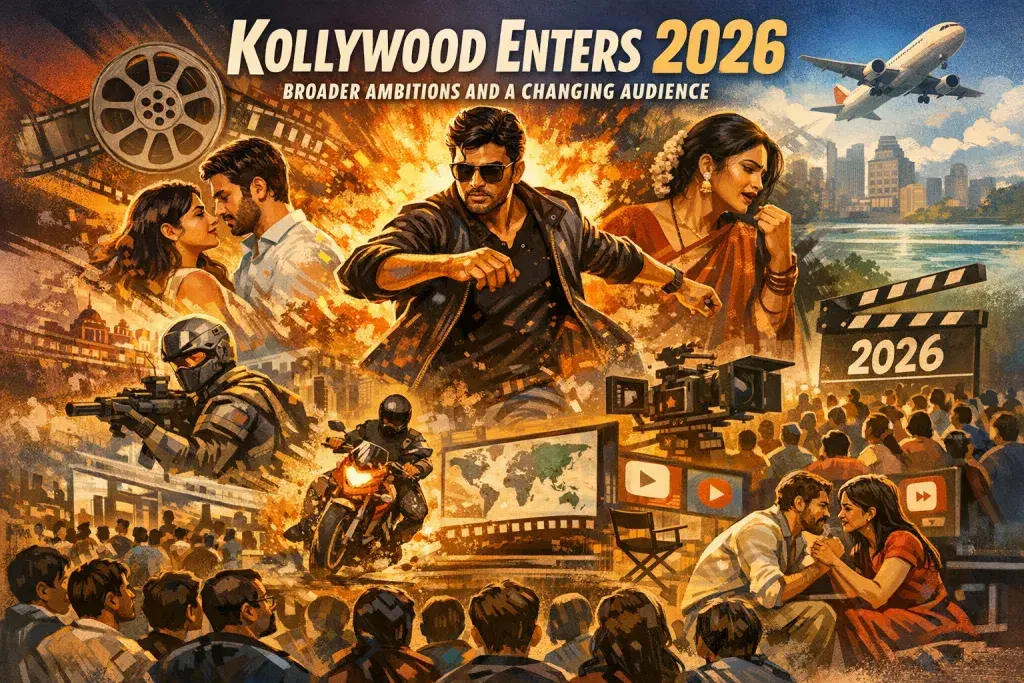
Tamil cinema is releasing a wider range of films in 2026 than at any comparable point in the past decade — not simply in volume, but in the variety of storytelling approaches, budget scales, and genre intentions on display. From large-scale productions anchored by established stars to smaller, character-driven films spreading through word of mouth, the year's theatrical slate reveals an industry increasingly willing to test what its audience will accept and reward. For anyone tracking Tamil film releases, 2026 offers both familiar pleasures and genuine surprises.
A Slate That Reflects Shifting Priorities
The films arriving in 2026 span a broad spectrum. On one end sit the big-budget star vehicles — productions built around marquee names, designed for maximum theatrical impact and wide release across Tamil Nadu and diaspora markets globally. On the other end are films like Manithan Deivamagalam and Neelira, which appear to prioritise narrative intimacy over spectacle, relying on content strength and audience trust rather than star power alone.
The April 2026 cluster alone illustrates this diversity. Taxila, LIK: Love Insurance Kompany, TN 2026, Kaalidas 2, Carmeni Selvam, Biker, and Leader arrived within the same calendar month, covering action, romance, drama, and social commentary. The genre spread within a single four-week window reflects a deliberate response to audience fragmentation — different films chasing different viewers simultaneously, rather than a single production dominating the conversation.
The Logic Behind Kollywood's Expanding Genre Range
Tamil cinema has historically leaned on a recognisable commercial grammar: a hero-centric narrative, songs integrated into the plot, action sequences, and a resolution that affirms social or moral order. That grammar has not disappeared, but it is increasingly being written around rather than simply followed. The presence of a thriller like TN 2026 alongside a romance like Nee Forever — released in March — and a fantasy or drama like Neelira in the same year suggests that filmmakers are reading audience appetite more carefully.
Streaming platforms have played a quiet but significant role in reshaping what Tamil audiences consider worth watching in a theatre. Viewers who consume international content regularly have developed tolerance for slower pacing, morally complex characters, and non-linear structure. Films that would have struggled to find theatrical space five years ago now carry credible commercial prospects, because the audience arriving at a multiplex in Chennai or Coimbatore is not the same audience it was in 2015.
Sequels, Franchises, and the Return of Familiar Properties
Kaalidas 2 represents a pattern worth noting: the sequel or franchise extension has become a more confident fixture in Kollywood's planning than it once was. Tamil cinema was historically resistant to serialised storytelling — each film was expected to stand alone, and stars rarely reprised characters across multiple productions. That reluctance is fading. Successful sequels have demonstrated that Tamil audiences are willing to return to characters they already trust, provided the second instalment delivers narrative progression rather than mere repetition.
This shift carries both creative and commercial implications. Sequels reduce a specific kind of financial risk — the cost of building audience familiarity from zero — but they introduce a different pressure: the obligation to justify the continuation. A sequel that fails to expand on its predecessor does measurable damage to the property as a whole, a risk that standalone films do not carry in the same way.
What the 2026 Release List Signals About Kollywood's Near-Term Direction
Tracking Tamil film releases in 2026 is not merely a matter of noting what has arrived in cinemas. The pattern of what gets made, funded, and greenlit reflects decisions taken one to three years earlier — meaning the slate visible now is a record of where producers placed confidence in 2023 and 2024. The diversity on display suggests that confidence was distributed more broadly than in previous cycles: not concentrated solely in two or three dominant productions, but spread across a range of formats, genres, and budgets.
Whether that distribution holds through the rest of 2026 will depend in part on which films perform well enough to validate the approach. A strong run for a content-driven drama like Manithan Deivamagalam would reinforce the case for financing similar projects. A poor showing for a mid-budget action film would prompt recalibration. Tamil cinema, like any creative industry shaped by both artistic intent and commercial reality, adjusts its priorities based on what the audience demonstrates it values. The 2026 slate is, in that sense, both a product of past decisions and a test of future ones.