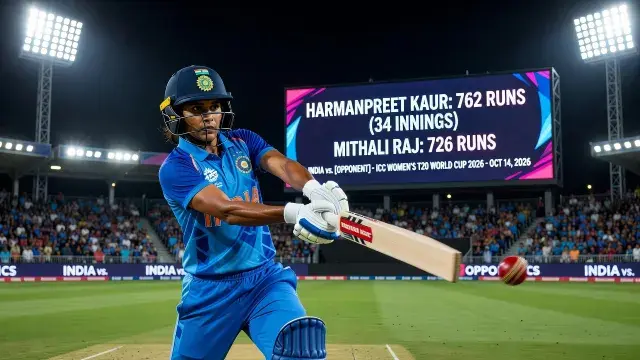
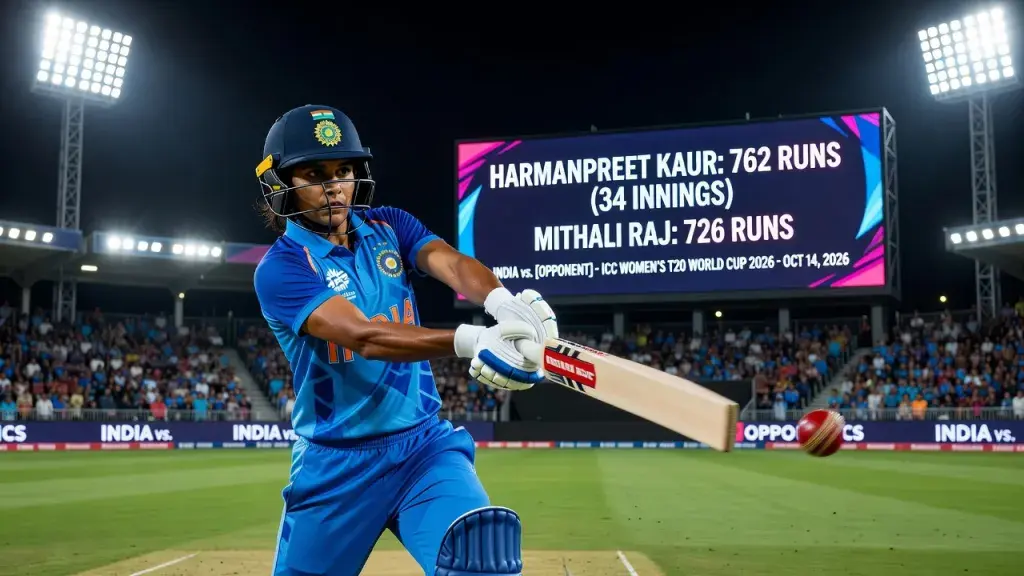
India captain Harmanpreet Kaur has etched her name into the record books by becoming her country's highest run-scorer in ICC Women's T20 World Cup history. Surpassing the 726-run tally set by the legendary Mithali Raj, Harmanpreet now stands at 762 runs across 34 innings, a milestone achieved during India's opening fixture of the 2026 Women's T20 World Cup. It is the kind of landmark that crystallises a career built not just on talent, but on sustained excellence across formats and generations.
The significance of the record extends well beyond the numbers. Harmanpreet's journey to the top of this particular list has spanned nearly two decades, from a teenage debut on the global stage to her current role as one of the most recognisable captains in women's cricket. That longevity alone places her in rare company, and in a sporting landscape where attention moves quickly across disciplines - from the Women's Premier League to icehl fixtures contested thousands of miles away - her consistency at the highest level commands genuine respect. Few athletes in any sport maintain this level of performance and relevance over such an extended period.
Mithali Raj's 726 runs had stood as the definitive measure of Indian batting quality in T20 World Cups, a product of her elegant technique and remarkable consistency over more than a decade of international cricket. Harmanpreet's overtaking of that figure is not a diminishment of Mithali's legacy - it is, if anything, a continuation of it. Where Mithali embodied precision and composure, Harmanpreet has redefined what Indian women's batting looks like in the modern era: aggressive, fearless, and capable of shifting the momentum of a match in the space of a single over. The contrast between the two players mirrors the broader evolution of T20 cricket itself, from accumulation to calculated destruction.
Pressure Innings and the Art of Delivering When It Counts
What separates Harmanpreet's 762 World Cup runs from a straightforward tale of accumulation is the context in which many of those runs were scored. Knockout pressure, elite opposition, high-stakes settings - these have historically been the conditions under which she has produced her most defining contributions. Her unbeaten 171 against Australia in the 2017 Women's ODI World Cup semi-final, though a 50-over performance, remains one of the most celebrated innings in the history of women's cricket, a reminder of what she is capable of when everything is on the line. In T20 cricket, that same instinct has repeatedly surfaced: steadying innings after early wickets, or shifting gears in the death overs with the kind of timing and power that changes match dynamics entirely.
Captain, Catalyst, and the Bigger Picture for Indian Women's Cricket
As captain, Harmanpreet has shaped more than just India's batting order. Her leadership philosophy - built around fearless intent and backing younger players - has helped create a dressing room culture capable of absorbing pressure without retreating into conservatism. The Women's Premier League has played its part too, giving Indian players exposure to world-class conditions and teammates, and Harmanpreet has been among the competition's standout performers. That franchise experience has fed directly back into her international game, adding layers to a batter who was already dangerous at the highest level.
At 36, the question of how long she continues is a legitimate one, but there is little in her current form or fitness to suggest the record will stop climbing anytime soon. She is also closing in on the leading overall run-scorers in Women's T20 World Cup history, a conversation that will only grow louder as the 2026 tournament progresses. For India's fans, and for the wider women's game, Harmanpreet Kaur's place at the top of this list feels less like a statistical footnote and more like confirmation of something they have known for years: that she belongs among the finest white-ball cricketers of her generation, regardless of format or gender.